
Table of Contents
It’s the kind of bathroom where the mirror lights do all the work. The window (if there is one) is frosted, tiny, or blocked by a diffuser—so “daylight” feels more like a suggestion than a resource.
If your plants keep fading in here, it’s usually not because you “don’t have a green thumb.” It’s because bathrooms without real sun require plants that tolerate low light and the quirks of humidity, steam, and tight surfaces.
This is a curated selection of bathroom plants no sunlight—with quick rules to help you choose what actually matches your bathroom’s light level and placement.
First: what “no sunlight” really means in a bathroom
Some bathrooms have weak natural light (frosted windows, skylights with diffuser film). Others are truly windowless, where plants live on artificial light alone.
A simple way to choose:
- If you can read a label without turning lights on, you’re in weak natural light territory.
- If the bathroom is dark until you flip a switch, you’re in windowless / artificial-light territory.
Either way, avoid the biggest trap: soggy soil. Steam is great. Constantly wet potting mix is not.
Expectation reset: the 9 “full profile” plants below do best when your bathroom gets some steady light most days—diffused daylight, vanity lighting, or regular ceiling light use. If your bathroom stays dark most of the day, jump to the quick-mention sections for true lights-only survivors and fixes.
Full profiles: 9 bathroom plants that handle little-to-no sunlight
#1 — Lucky Bamboo (Dracaena sanderiana)
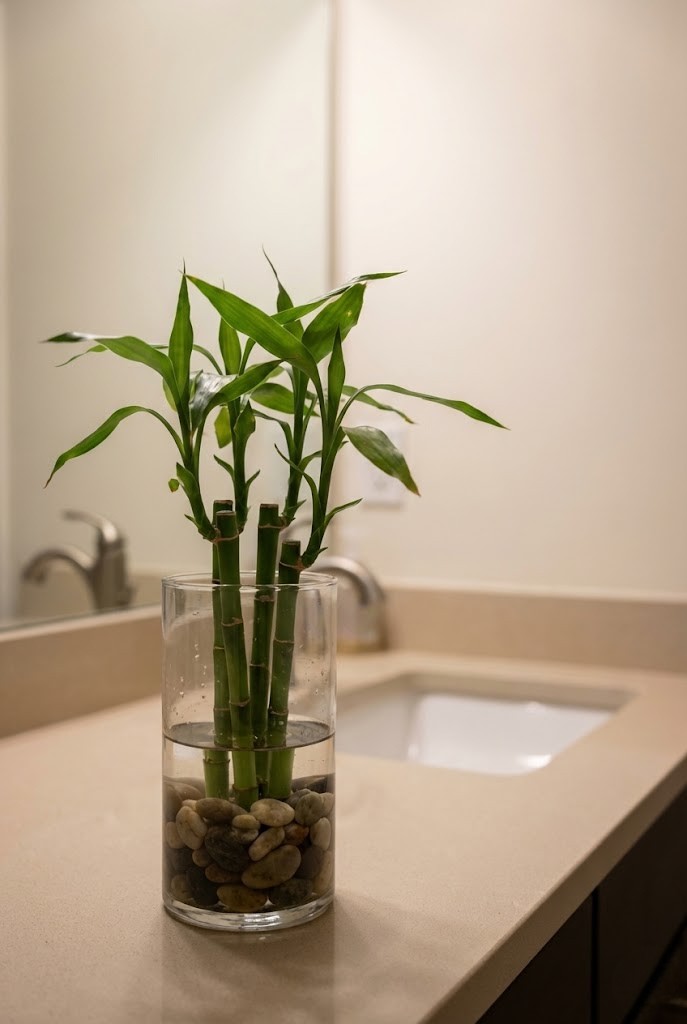
Lucky bamboo is the fastest way to make a bathroom feel calm. A glass container with pebbles looks spa-like even on a tiny counter, and the plant stays upright without taking over.
It’s especially good for sink-counter styling in weak, indirect light. In real homes, it’s the plant that still looks intentional even when the bathroom is all tile and no warmth.
If you grow it in water, keep the roots submerged and refresh the water regularly so it stays clean and odor-free.
#2 — Golden Pothos (Epipremnum aureum)
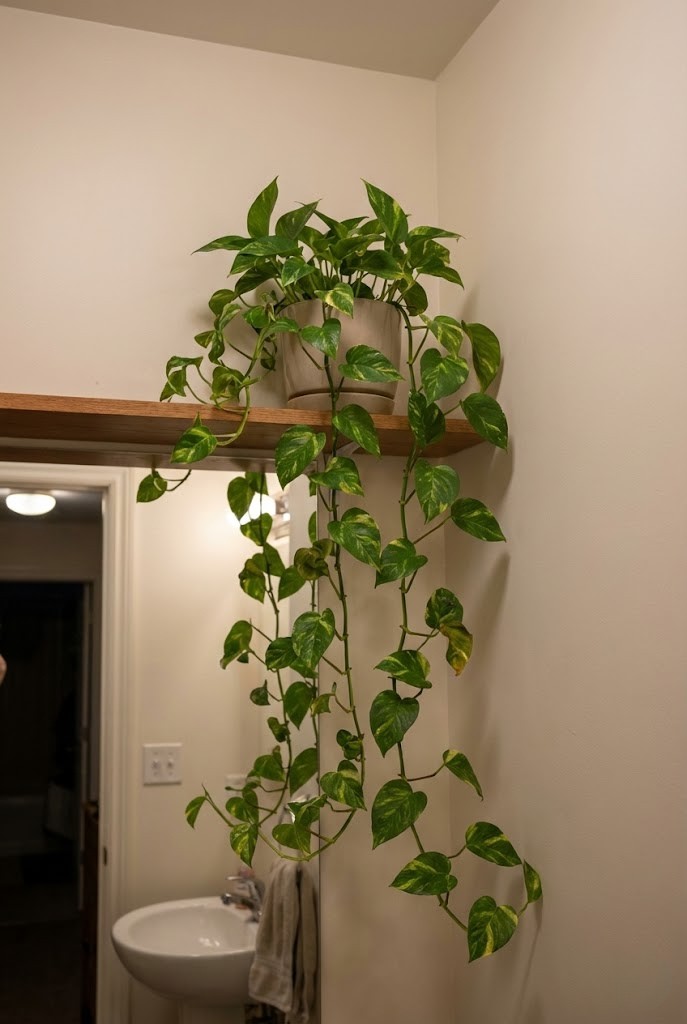
Golden pothos is the “soften everything” plant. In a bathroom, its vines drape down from a shelf and instantly make hard edges—mirror, tile, cabinet—feel less sharp.
It tolerates low light well when it gets steady daily light (even if it’s mostly artificial). Place it above the toilet or on a high shelf where the vines can fall freely without getting splashed.
⚠️ Note: Toxic to pets if ingested.
#3 — Heartleaf Philodendron (Philodendron hederaceum)
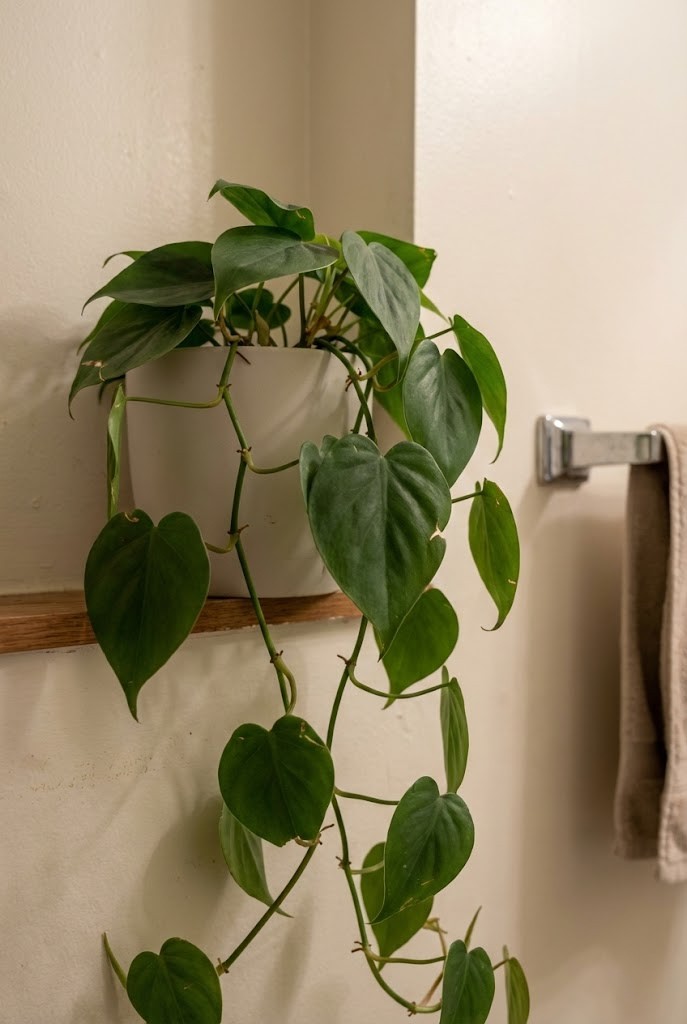
Heartleaf philodendron reads calmer than pothos. The leaves are matte and slightly heart-shaped, so the look is softer and more “quiet,” especially in small bathrooms.
It’s perfect on a stool near the towel rack or a shelf that gets indirect light. In low light, it grows slower—often a good thing in bathrooms where you want tidy, controlled greenery.
⚠️ Note: Toxic to pets if ingested.
#4 — Spider Plant (Chlorophytum comosum)
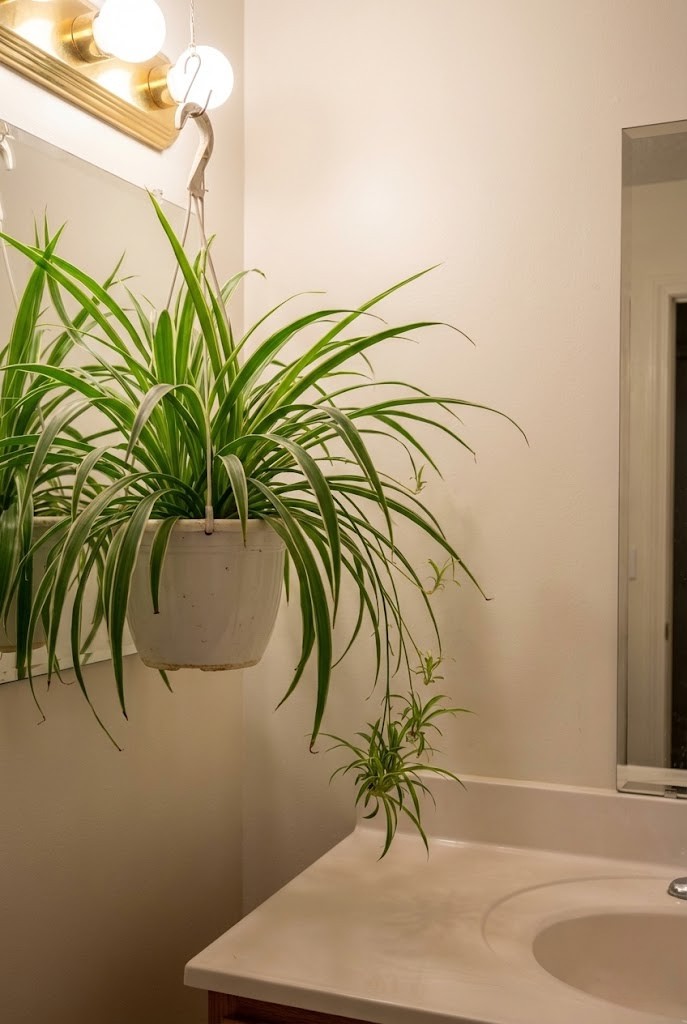
Spider plants handle bathroom humidity well and look great when the baby “spiderettes” start cascading.
The key is placement: they love moist air, but they don’t love being soaked. Hang it near vanity lights or keep it on a high shelf away from direct splash zones so the potting mix doesn’t stay soggy.
If your bathroom is dim most of the day, spider plant does best when lights are used regularly—not just for 10 minutes in the morning.
#5 — Satin Pothos (Scindapsus pictus)
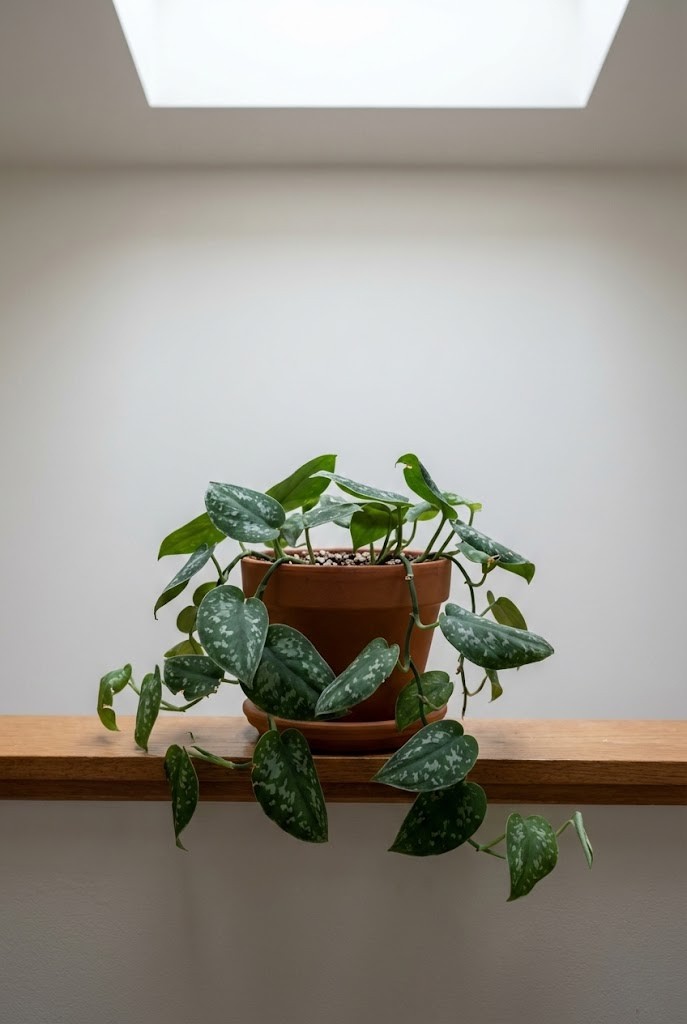
Satin pothos is for when you want something that still looks special in low light. The silvery leaf pattern catches small amounts of light—diffused skylight, a frosted window, or vanity lighting—and gives the plant a “finished” look.
Use it on a high wall shelf or a floating shelf above the toilet. Keep the potting mix lightly moist, not wet, especially in steamy bathrooms.
⚠️ Note: Toxic to pets if ingested.
#6 — Arrowhead Vine (Syngonium podophyllum)
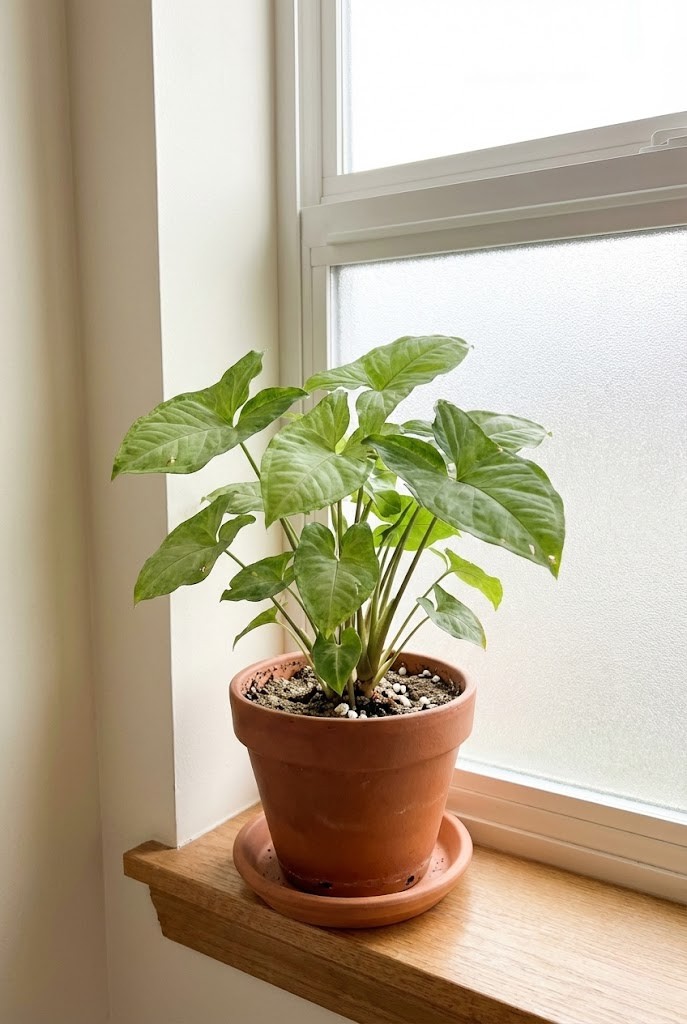
Arrowhead vine adds a different silhouette—more pointed, layered leaves—so it’s a nice change if your bathroom already has trailing plants.
It does well in weak indirect light and appreciates humidity. Place it on a shelf where it’s easy to rotate occasionally, since it will gently lean toward the brightest part of the room.
If it starts getting leggy, trimming it back makes it fuller—and the cuttings root easily if you like propagating.
⚠️ Note: Toxic to pets if ingested.
#7 — Baby Rubber Plant (Peperomia obtusifolia)
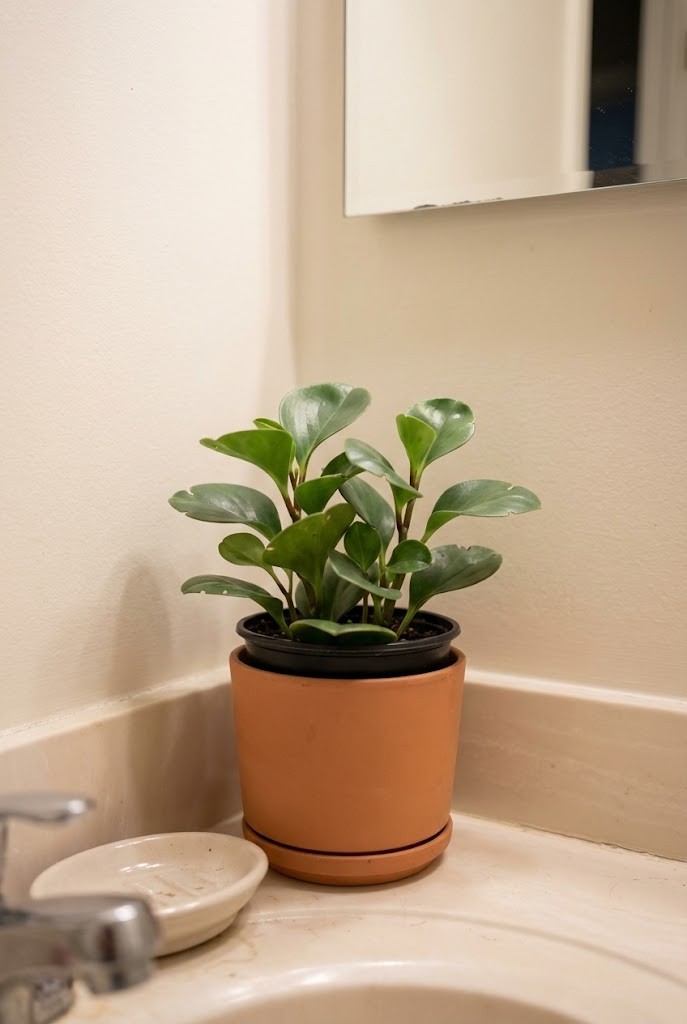
If you want a bathroom plant that stays compact and non-shedding, baby rubber plant is a strong pick. The leaves are thick and glossy, so it looks “clean” on a vanity without constantly dropping debris.
It tolerates low light better than many small houseplants, especially when it gets steady artificial light. Place it on the vanity corner or a shelf where it won’t get drenched.
Let the top of the soil dry between waterings—thick leaves mean it stores moisture.
#8 — Prayer Plant (Maranta leuconeura)
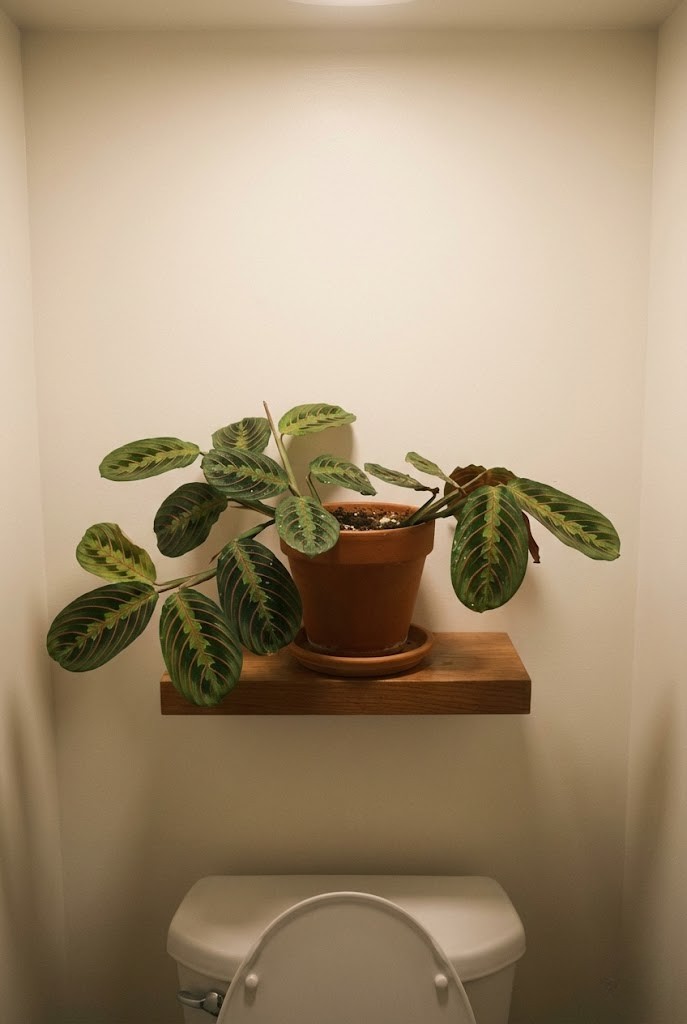
Prayer plants bring pattern without harshness. The leaves look almost painted, and in a bathroom they feel like a quiet detail—soft, decorative, and a little cozy.
They like humidity and do well in low to medium indirect light, which makes them a natural fit for bathrooms with frosted windows or consistent vanity lighting. Put one where you see it up close—this is a plant that rewards small-space viewing.
#9 — Rattlesnake Plant (Calathea lancifolia)
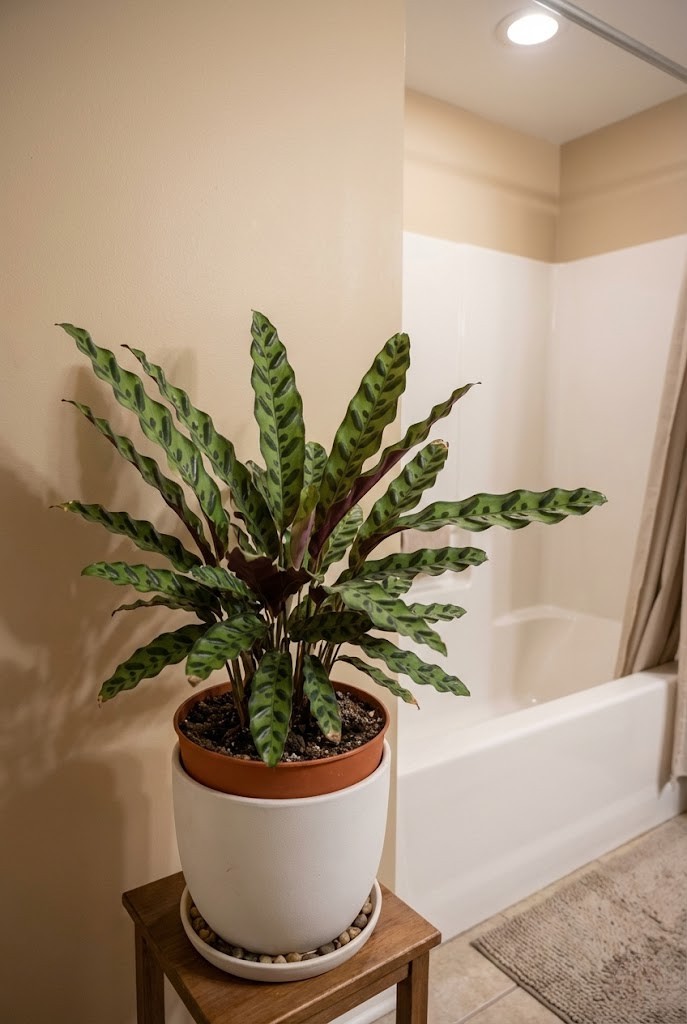
Rattlesnake plant gives you bold, graphic leaf pattern that still feels calm in a bathroom. The long, wavy leaves look great against tile, and humidity helps it stay happier than it would in a dry living room.
Keep it in low-to-medium indirect light and place it outside the splash zone near the tub or shower. Steamy air is great; constantly wet soil is not.
Quick mention: Windowless bathrooms (lights-only)
If your bathroom has no window at all, these four are the classic “tolerate artificial light” picks:
- ZZ Plant (Zamioculcas zamiifolia)
- Snake Plant (Dracaena trifasciata)
- Cast Iron Plant (Aspidistra elatior)
- Chinese Evergreen (Aglaonema)
Reality check: windowless bathrooms need a routine—8–10 hours/day of artificial light helps plants stay stable instead of slowly declining.
For full placement zones + lighting hours, read: Plants for bathroom with no windows.
Quick mention: Low-light bathrooms (weak daylight + high humidity)
If you have weak natural light plus lots of steam, these are the humidity-forward choices:
- Boston Fern (Nephrolepis exaltata)
- Bird’s Nest Fern (Asplenium nidus)
- Peace Lily (Spathiphyllum)
- Aluminum Plant (Pilea cadierei)
These do best when there’s at least a little daily light (frosted window or regular vanity use) and the air stays humid after showers.
For styling zones and the best placements in real bathrooms, read: Low-light bathroom plants.
Quick mention: Near-zero light (be honest + fix the light)
If your bathroom stays dark most of the day and lights are rarely on, keep expectations realistic. These are better “survivors,” but they still need a lighting routine:
- Dracaena ‘Janet Craig’ (Dracaena fragrans ‘Janet Craig’)
- Corn Plant (Dracaena fragrans)
- Dracaena marginata
- Parlor Palm (Chamaedorea elegans)
Near-zero light isn’t a plant problem—it’s a schedule problem. A timer + brighter bulb changes everything.
For the honest approach + lighting fixes, read: No light bathroom plants.
Conclusion
“No sunlight” bathrooms can absolutely have plants—you just have to match the plant to what your bathroom actually provides: weak daylight, lights-only, or near-zero light.
Start with one full-profile option that fits your surface (sink, shelf, tub corner), then build from there. When the placement is realistic and the light is consistent, even the most window-poor bathroom can feel fresh, calm, and finished.