Table of Contents
Thanksgiving cactus and Christmas cactus are easy to confuse. Both are popular houseplants, and both put on a colorful show around the winter holidays. They also have similar growing needs.
Look a little closer, though, and you’ll find several ways to tell them apart.
If you only check one thing, look at the edges of the plant’s segmented stems. What look like leaves are actually flattened stems called cladodes, and their shape is the most reliable way to identify these holiday cacti. Here’s what to look for.
1. Check the Edges of the Stem Segments
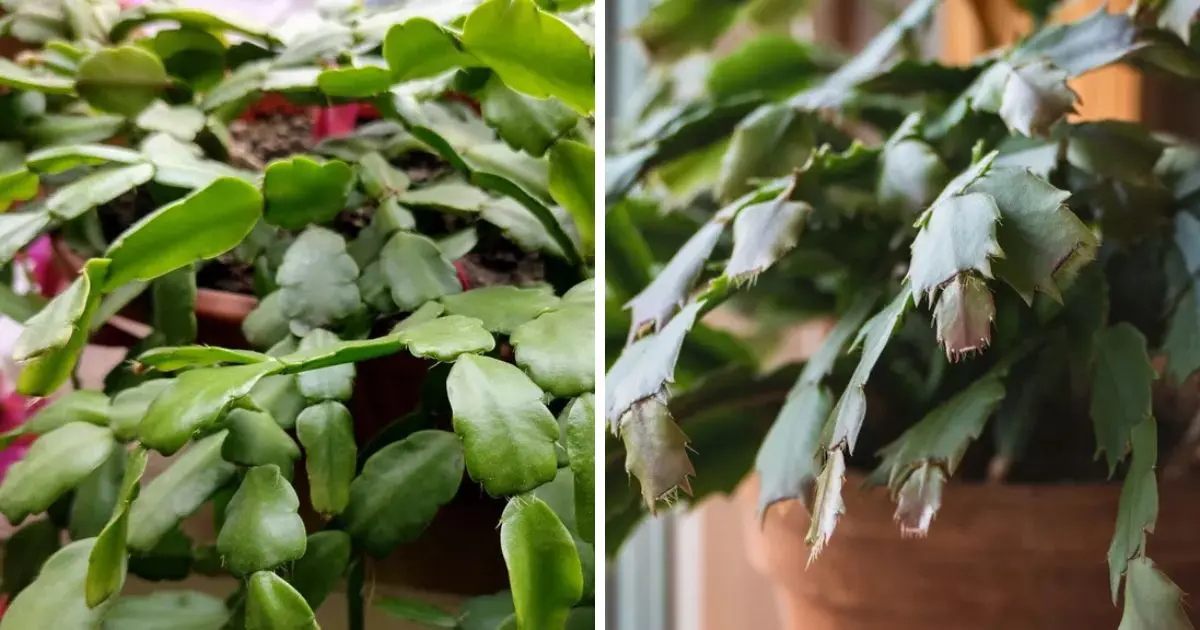
left: Christmas cactus leaves and right: Thanksgiving cactus leaves
Start with the edges of several stem segments. This is the clearest way to distinguish a Thanksgiving cactus from a Christmas cactus.
A Thanksgiving cactus (Schlumbergera truncata) has two to four pointed, toothlike projections along the edges of each segment. They can look a little like crab claws.
A Christmas cactus (Schlumbergera × buckleyi) has rounded, scalloped edges instead. The segments don’t have the sharp points found on Thanksgiving cactus. This is the best clue to use when your plant isn’t flowering.
2. Look at How the Flowers Grow
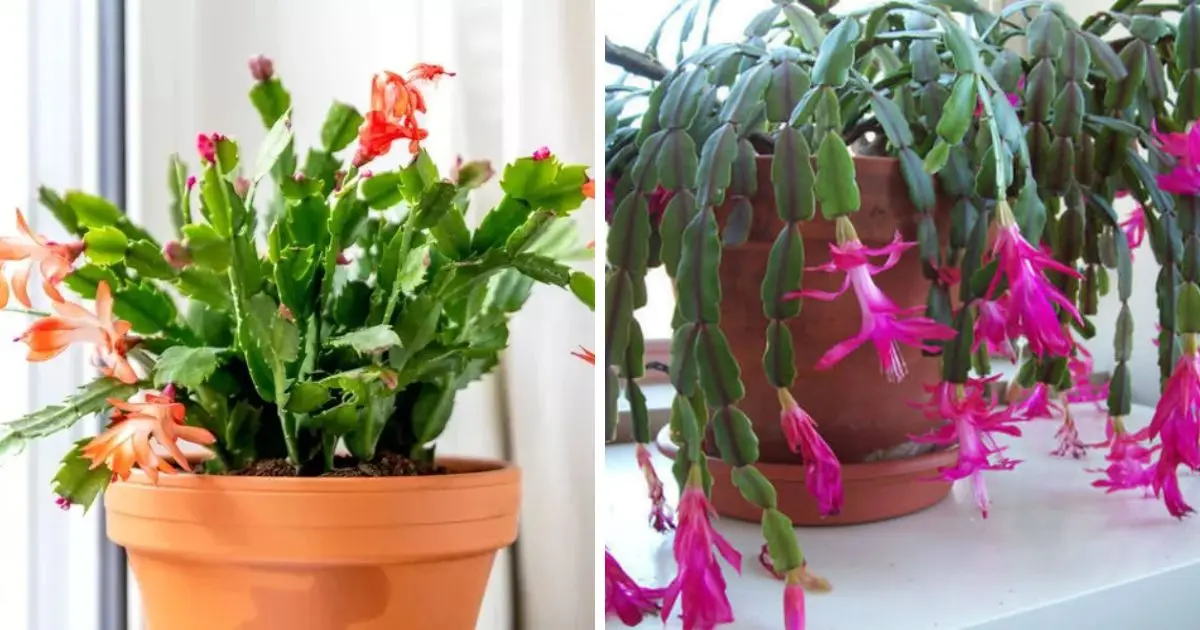
Left: Thanksgiving Cactus and Right: Christmas Cactus
If your cactus is blooming, take a look at how the flowers sit on the plant.
Thanksgiving cactus flowers tend to grow more upright from the ends of the stems. Christmas cactus flowers generally hang downward.
Flower color isn’t as helpful. Both types can have flowers in shades of white, pink, red, and other colors, so don’t use color alone to identify your plant.
3. Check the Anthers
There’s another clue hiding in the center of the flower: the anthers, or pollen-producing structures.
Thanksgiving cactus has yellow anthers, while Christmas cactus has pink to purple-brown anthers.
You’ll need an open flower to see this difference, so use it to confirm what you see in the stem segments rather than as your first method of identification.
4. Consider When It Blooms
The common names give you a rough idea of when these plants flower. Thanksgiving cactus typically blooms from mid-November to late December. True Christmas cactus generally flowers from late November into early February.
Bloom time is useful, but it isn’t as reliable as stem shape. Light and temperature affect when holiday cacti form flower buds, and hybrid cultivars can have different flowering habits.
So if your cactus blooms in November, don’t assume it’s a Thanksgiving cactus. Take a look at the stem edges, too.
Why Your “Christmas Cactus” May Actually Be a Thanksgiving Cactus
The plant’s label isn’t always a reliable identification. Most plants sold as “Christmas cactus” are actually Thanksgiving cactus or hybrids.
Thanksgiving cactus is widely available during the fall and holiday season, and growers can manipulate light and temperature to bring plants into bloom around Christmas.
That’s one reason these plants are so often mislabeled. And because many holiday cactus cultivars are hybrids, some plants won’t match the classic descriptions perfectly.
When you’re unsure, go back to the stem segments. Their shape is still your best starting point.
How to Get Your Holiday Cactus to Bloom
If your Thanksgiving or Christmas cactus isn’t flowering, its light and temperature may be the reason. Holiday cacti form flower buds as the days get shorter and the nights get longer.
To encourage blooming, give the plant about 12 to 14 hours of uninterrupted darkness each night for several weeks. Even artificial light during the dark period can interfere with bud formation.
Cool temperatures help, too. In late summer and fall, keep the plant in a cool spot around 55 to 65°F, with bright light during the day and no artificial light at night. Temperatures above 70°F can prevent flowering.
Once buds appear, try not to move the plant or make sudden changes to its light, temperature, or watering. Those changes can cause flower buds to drop.
What About Easter Cactus?
Thanksgiving and Christmas cacti aren’t the only holiday cacti you’ll find as houseplants.
Easter cactus (Rhipsalidopsis gaertneri) flowers primarily in spring, usually from March through May. Its stem segments are smoother and more rounded, with four to six slight ripples and small bristles at the tips.
Its flowers are also more star-shaped than those of Thanksgiving and Christmas cactus, so the plant is easier to recognize when it’s in bloom.
Thanksgiving Cactus vs. Christmas Cactus at a Glance
| Feature | Thanksgiving Cactus | Christmas Cactus |
| Stem segment edges | Pointed, toothed | Rounded, scalloped |
| Flower position | More upright | Hangs downward |
| Anther color | Yellow | Pink to purple-brown |
| Typical bloom time | Mid-November to late December | Late November to early February |
When you’re trying to identify a holiday cactus, start with the stem segments. Pointed, toothed edges are the giveaway for Thanksgiving cactus, while rounded, scalloped edges point to Christmas cactus.
The flowers and bloom time can help confirm what you see, but they shouldn’t outweigh the shape of the stems.