Table of Contents
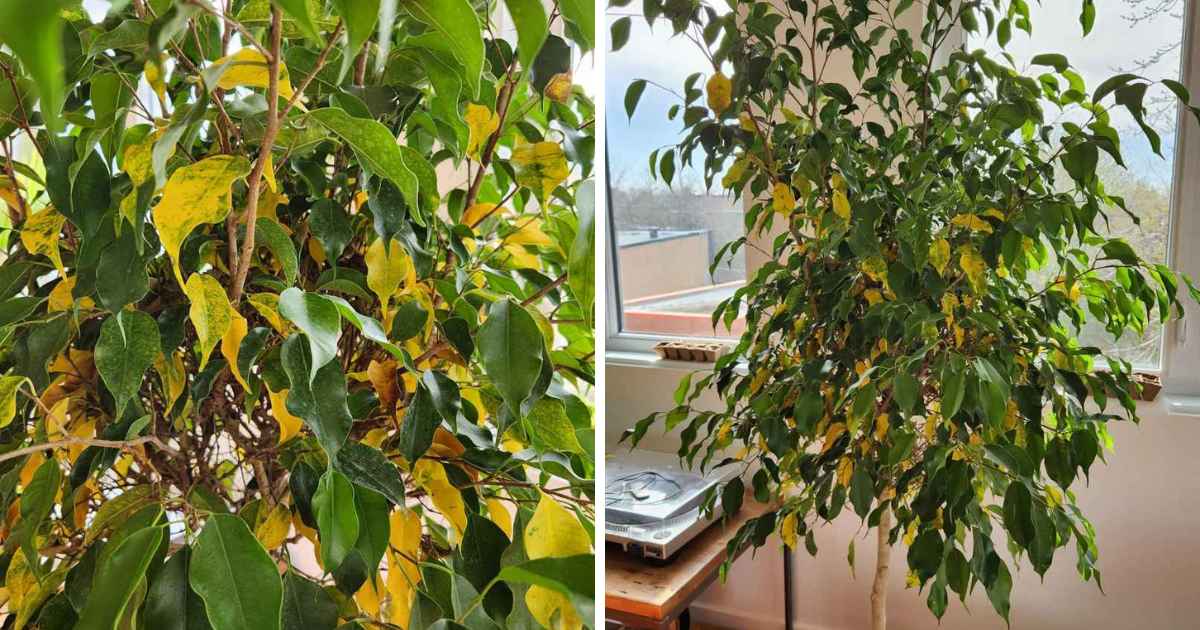
A few yellow leaves aren’t always a disaster—but on a Ficus benjamina, they deserve attention before the problem spreads.
One week your weeping fig appears perfectly healthy; the next, a pale, faded hue begins to creep through the foliage.
Yellow leaves are one of the earliest signs that a weeping fig is under stress, but the underlying cause isn’t always the same. Finding the right remedy requires looking closely at the texture, location, and pattern of the yellowing, rather than just the color change itself.
Credit: reddit
1. Overwatering and Root Rot
The most common and lethal trigger for widespread yellowing is prolonged soil saturation, a crisis that requires immediate intervention.
When soil remains continuously wet, oxygen cannot reach the root zone, causing the fine roots to rot and lose their ability to absorb nutrients. This leaves the lower, older leaves to turn a soft, uniform yellow and drop while still pliable.
If the potting medium has degraded into a thick, muddy paste, simply letting it dry won’t solve the underlying decay. Check that the drainage holes are completely clear; if the soil is compacted and sour, gently slip the tree from its container, trim away any mushy root tips, and repot it into a fresh, well-aerated mix packed with perlite.
2. Underwatering
While overwatering turns leaves a soft, dull yellow, a severe lack of moisture dries them out from the bottom up.
When a Ficus goes too long without water, it selectively sacrifices its oldest foliage to preserve moisture for the core of the plant. Drought-stressed leaves develop patchy yellowing, curl inward, and feel dry or crispy before they fall.
Avoid giving the plant shallow, frequent sips, which often leave the lower root ball bone-dry. Instead, give the pot a thorough soak in the sink or shower until water runs freely out of the bottom, then resume a consistent schedule based strictly on soil dryness.
3. Light Deprivation
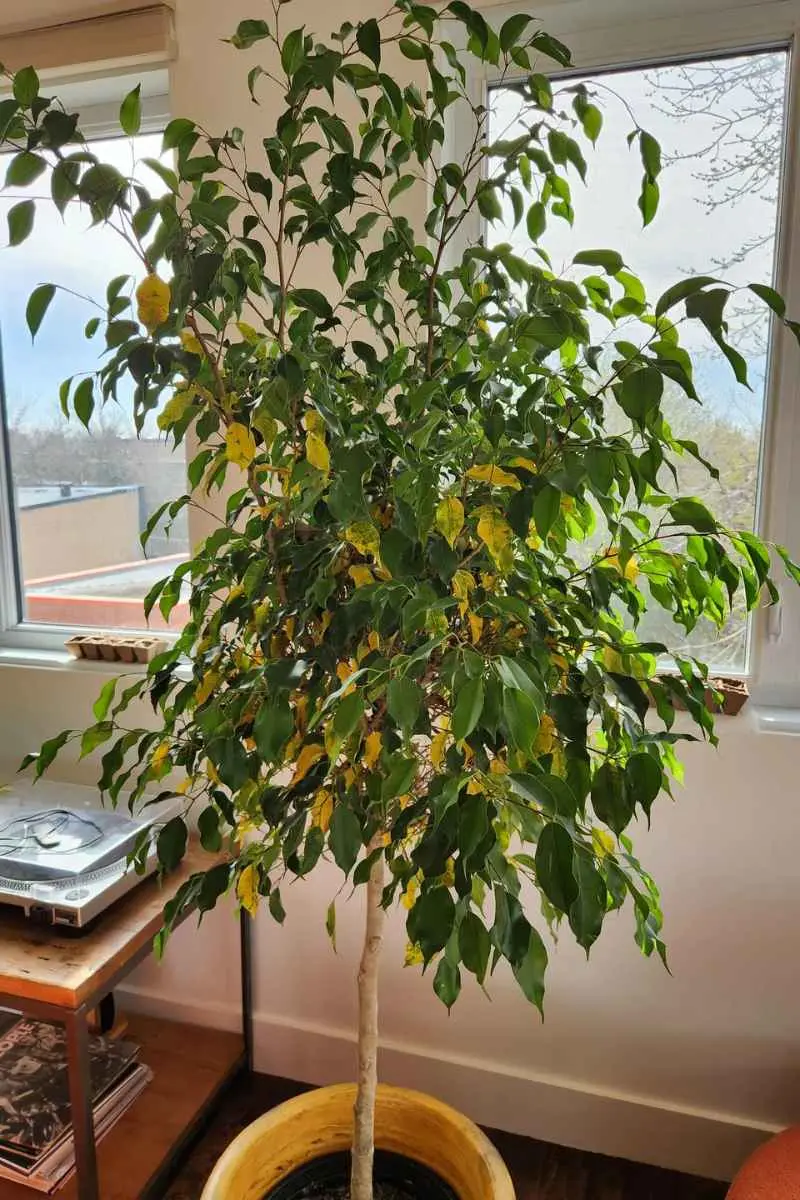
When a weeping fig is placed too far from a light source, its lower and interior leaves slowly lose their deep green hue. The tree naturally sheds this interior foliage first, abandoning the leaves that receive the least light to redirect its resources toward the outer canopy.
This specific yellowing is slow and predictable, creeping outward from the center of the tree over several months.
To stop this thinning, relocate the tree closer to an east- or west-facing window for ample bright, indirect light. In dimly lit rooms, position a dedicated LED grow light 12–18 inches above the canopy for 12 hours a day provides a reliable energy baseline to stop the decline.
4. Root-Bound Ficus
Credit: reddit
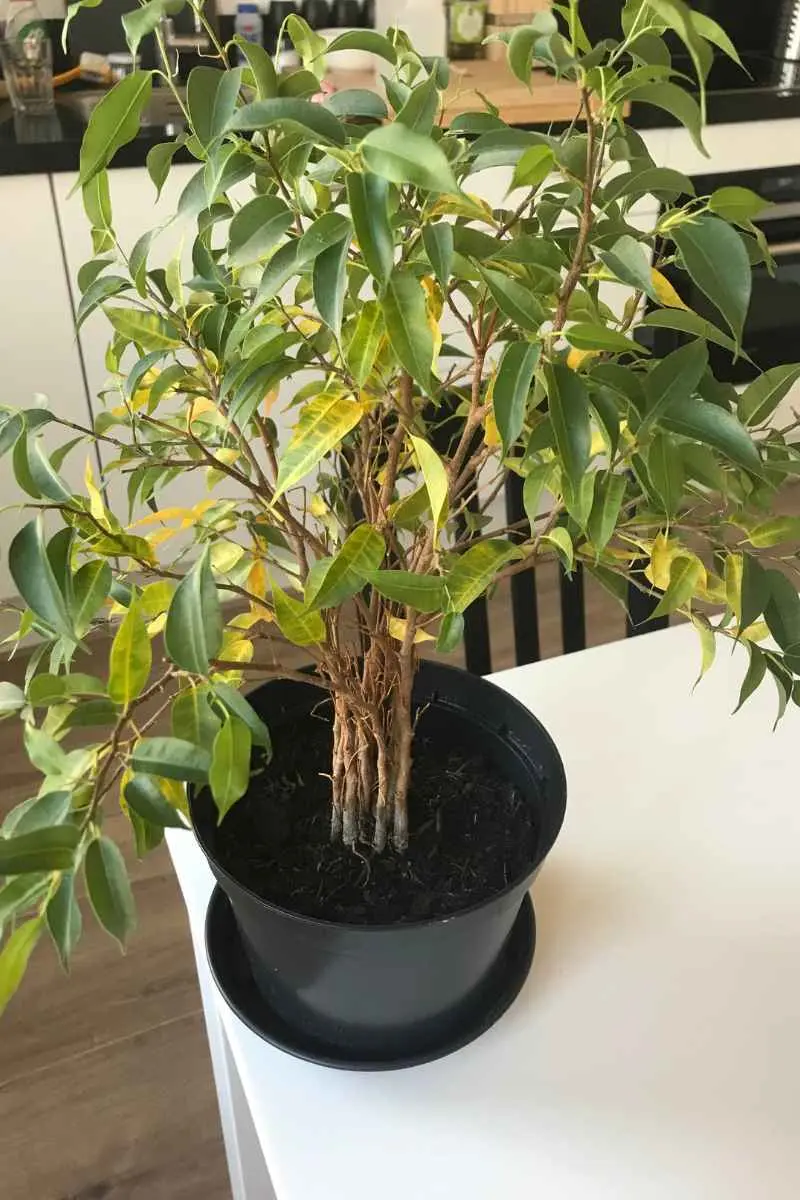
If the entire canopy of your Ficus is slowly fading into a uniform, pale chartreuse but the leaves remain firmly attached to the branches, the root system is likely out of room. This usually happens when a weeping fig has stayed in the same pot for years.
The roots eventually fill the container, leaving little room for fresh soil or efficient nutrient uptake. Do not apply heavy doses of fertilizer out of panic, as this will burn the remaining healthy roots.
If you see roots circling the bottom of the pot, wait until spring to repot it into a container about two inches wider using fresh potting mix. If repotting isn’t an option, introduce a balanced indoor houseplant fertilizer diluted to half-strength only during active spring growth.
5. Hidden Pests
Yellowing that appears as tiny, mottled speckles across the leaf surface is a telltale sign of an unchecked pest problem. Weeping figs are particularly susceptible to spider mites, which leave fine webbing and yellow speckles on the undersides of leaves.
Scale insects are another common culprit, appearing as small brown bumps on stems that often leave behind a sticky residue.
If you spot these physical signs, wash the canopy thoroughly with a gentle stream of lukewarm water to knock down the pest population, then treat the plant with insecticidal soap or organic neem oil, paying close attention to the branch junctions.
6. Seasonal Changes in Light and Watering
As autumn light fades, your weeping fig naturally slows its growth. If your tree drops a small handful of yellow leaves every autumn right as the days grow shorter, your plant may not be sick at all.
Even perfectly watered weeping figs shed older, lower leaves each autumn as daylight hours dwindle and light levels decline naturally.
However, continuing to water at summer volumes during this transition will compound the problem, suffocating the roots and turning a natural seasonal adjustment into a heavy winter shed.
Scale back your watering frequency as winter approaches, allowing the soil to dry out significantly deeper in the pot than you would during the spring active growing season.
FAQs
Can yellow Ficus leaves turn green again?
No. Once a Ficus leaf has turned completely yellow, it will not turn green again.
The important thing is to correct the underlying cause so the remaining foliage stays healthy and new leaves emerge green. If only an occasional older leaf is yellowing, especially low on the plant, it may simply be natural aging. But widespread yellowing or yellowing on new growth usually signals a care problem that needs attention.
Why are only the tips of my Ficus leaves turning yellow?
Yellow tips paired with dry, brown edges usually point to low humidity or mineral buildup from tap water. Uniform yellowing across the entire leaf usually points to a different problem, such as watering stress.
Weeping figs thrive in humidity levels above 40%. If your indoor air is exceptionally dry due to winter heating, place a humidifier nearby or flush the soil thoroughly with filtered water to wash away accumulated salts.
How long does it take for a Ficus to grow new green leaves after fixing the issue?
Once the underlying stress is corrected, the yellowing should stop spreading within a couple of weeks.
If the branches are still supple and green under the bark, you will typically see fresh green tips re-emerge during the next active growing season, usually by mid-spring.